
A Local Attorney Explains
Hello, I’m Mark Jackson. I’ve spent years helping people in Florida understand what happens after a felony arrest. One question I hear all the time: “How does Florida’s criminal scoresheet work?” If you or someone you care about is facing charges, knowing how this point system works can make a huge difference in your outcome. Let’s walk through it together in plain language.
What Is Florida’s Criminal Scoresheet and Why Does It Exist?
Florida’s criminal scoresheet is a worksheet used by judges, prosecutors, and defense attorneys to decide what kind of sentence someone should get for a felony. The scoresheet is required by the Florida Criminal Punishment Code. The main goal is fairness—making sure similar crimes get similar sentences across the state. The system has been in place since 1998 and is updated regularly by the Florida Department of Corrections.
Key facts:
- The scoresheet applies to all felony cases in Florida.
- It uses a point system to “score” the severity of the crime and your criminal history.
- The higher the score, the more likely you’ll face prison time.
- If you score under 44 points, you may qualify for probation or community control instead of prison.
- If you score 44 points or more, the law says you must go to prison unless the judge finds a legal reason to go lower (called a “downward departure”).
Why does Florida use this system?
- To make sentencing more predictable and fair.
- To avoid huge differences in sentences for similar crimes.
- To help judges decide when probation is enough and when prison is required.
Want to see the official rules?
The Florida Department of Corrections has a full overview.
How Does Florida’s Criminal Scoresheet Work Step by Step?
Let’s break down the process from arrest to sentencing.
What Information Goes on the Scoresheet?
When you’re charged with a felony, the prosecutor fills out a scoresheet. Your defense attorney will review it for errors. Here’s what gets included:
- Primary offense: The most serious charge you’re facing.
- Additional offenses: Any other felonies or misdemeanors charged at the same time.
- Prior record: All prior adult convictions and some juvenile offenses.
- Victim injury: If anyone was hurt, extra points are added.
- Legal status: If you were on probation, parole, or escaped custody, more points.
- Enhancements: Use of a firearm, gang activity, or certain drug crimes can add points.
How Are Felony Points Calculated in Florida?
Each crime is assigned a level from 1 to 10. The more serious the crime, the higher the level. Each level has a set number of points.
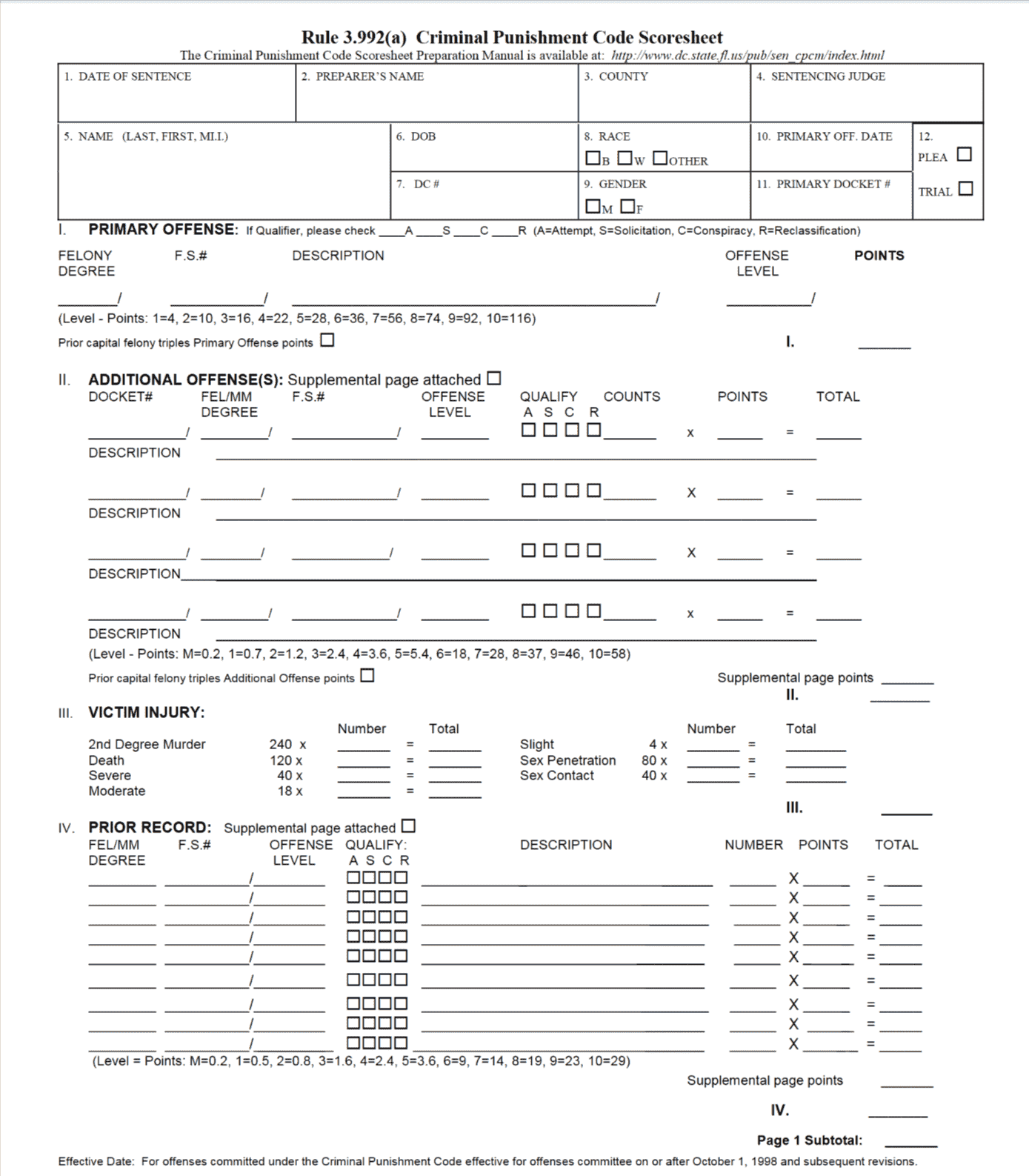
Updated Florida Criminal Scoresheet Point Values (2025)
Based on the most recent sources, here’s the corrected table:
| Offense Level | Primary Offense Points | Additional Offense Points | Prior Record Points |
|---|---|---|---|
| Level 1 | 4 | 0.7 | 0.5 |
| Level 2 | 10 | 1.2 | 0.8 |
| Level 3 | 16 | 2.4 | 1.6 |
| Level 4 | 22 | 3.6 | 2.4 |
| Level 5 | 28 | 5.4 | 3.6 |
| Level 6 | 36 | 18 | 9 |
| Level 7 | 56 | 28 | 14 |
| Level 8 | 74 | 37 | 19 |
| Level 9 | 92 | 46 | 23 |
| Level 10 | 116 | 58 | 29 |
Sentencing Thresholds:
-
22 points or fewer: Non-prison sentence (probation/community control)
-
22-44 points: Prison possible but not mandatory
-
44 points or more: Mandatory prison sentence (unless downward departure applies)
Prison Sentence Calculation Formula:
(Total Points – 28) × 0.75 = Minimum Months in Prison
How the Updated Points Affect Sentencing Examples:
Example 1: Multiple Felony Case
Before 2025 Updates:
-
Primary offense: Level 7 (56 points)
-
Additional offense: Level 6 (9 points – old value)
-
Prior record: Level 5 (2.4 points)
-
Total: 67.4 points
-
Prison calculation: (67.4 – 28) × 0.75 = 29.6 months minimum
After 2025 Updates:
-
Primary offense: Level 7 (56 points)
-
Additional offense: Level 6 (18 points – new value)
-
Prior record: Level 5 (2.4 points)
-
Total: 76.4 points
-
Prison calculation: (76.4 – 28) × 0.75 = 36.3 months minimum
Impact: 6.7 additional months in prison due to the point increase
Example 2: Serious Repeat Offender
Before 2025 Updates:
-
Primary offense: Level 8 (74 points)
-
Additional offense: Level 7 (14 points – old value)
-
Prior record: Level 8 (7.2 points – old value)
-
Total: 95.2 points
-
Prison calculation: (95.2 – 28) × 0.75 = 50.4 months minimum
After 2025 Updates:
-
Primary offense: Level 8 (74 points)
-
Additional offense: Level 7 (28 points – new value)
-
Prior record: Level 8 (19 points – new value)
-
Total: 121 points
-
Prison calculation: (121 – 28) × 0.75 = 69.75 months minimum
Impact: 19.35 additional months (over 1.5 years) in prison
Stat: Over 70% of felony sentences in Florida use this scoresheet system (Florida Sentencing Commission).
What Are the Key Parts of the Florida Criminal Scoresheet?
Offense Level Table
As shown above, each crime is assigned a level and point value. The primary offense gets the most points, additional offenses and prior convictions get less.
Prior Record and Legal Status
- Prior convictions: Even old convictions can add points, unless you’ve gone 10 years without any new convictions.
- Legal status: If you were on probation, parole, or escaped at the time of the crime, you get extra points.
Enhancements and Multipliers
Some situations add even more points:
- Victim injury: Physical injury or death adds points.
- Firearm use: 18 extra points for a firearm, 25 for a semiautomatic or machine gun.
- Drug trafficking: Points are multiplied by 1.5.
- Crimes against minors: Points may be doubled.
You can download a printable Florida scoresheet table here (PDF).
How Does the Scoresheet Affect Sentencing in Florida?
What Sentences Can Result from Different Point Totals?
| Total Points | Likely Sentence Type |
|---|---|
| 22 or fewer | Non-prison sentence (probation or community control) |
| 23-43 | Prison possible but not mandatory |
| 44+ | Mandatory prison sentence (unless downward departure) |
Prison Sentence Calculation Formula:
For cases scoring 44 points or higher, the minimum prison sentence is calculated as:
(Total Points – 28) × 0.75 = Minimum Months in Prison
Examples:
-
44 points: (44 - 28) × 0.75 = 12 months minimum -
60 points: (60 - 28) × 0.75 = 24 months minimum -
80 points: (80 - 28) × 0.75 = 39 months minimum
This updated threshold system reflects Florida’s 2025 changes, which lowered the non-prison threshold from 44 to 22 points, creating a middle category where prison is possible but not mandatory for scores between 23-43 points.
Downward Departure and Mitigating Factors
A judge can go below the required sentence if there are special reasons, like:
- The defendant played a minor role.
- Unusual circumstances.
- The victim requests mercy.
Mistakes and Corrections
Mistakes on scoresheets happen more often than you might think. Common errors:
- Wrong offense level.
- Old convictions counted when they shouldn’t be.
- Incorrect enhancements.
A miscalculation can add years to a sentence (Florida Bar).
If you think your scoresheet is wrong, talk to your lawyer right away. You can also learn more about appealing a criminal sentence in Florida.

Florida Criminal Scoresheet Calculation Example (Step by Step)
Let’s walk through a real example together.
Example Case: Drug Offense with Prior Record
Imagine you’re charged with a third-degree felony for drug possession (Level 3 offense, 16 points). You also have a prior conviction for theft (Level 2, 0.8 points as prior record).
- Primary offense: Level 3, 16 points
- Prior record: Level 2, 0.8 points
- No additional offenses or enhancements
Total points: 16 + 0.8 = 16.8 points
Since this is under 44, you’re eligible for probation.
Calculating the Total and Interpreting the Result
Now, let’s try a more serious example.
- Primary offense: Level 7, 56 points (e.g., aggravated battery)
- Additional offense: Level 3, 2.4 points
- Prior record: Level 5, 2.4 points
- Victim injury: Moderate, 18 points
- Legal status: On probation, 4 points
Total: 56 + 2.4 + 2.4 + 18 + 4 = 82.8 points
Minimum prison sentence:
(82.8−28)×0.75=41.1(82.8−28)×0.75=41.1
So, the judge must sentence at least 41 months in prison unless there’s a legal reason to go lower.
What If the Scoresheet Is Wrong?
If you spot a mistake:
- Tell your attorney right away.
- Ask for a corrected scoresheet.
- If not fixed, you can challenge it in court or on appeal.
You can download a sample worksheet here.
How Can You Check or Challenge Your Florida Criminal Scoresheet?
Who Prepares and Reviews the Scoresheet?
- Prosecutor: Fills out the first draft.
- Defense attorney: Checks for errors and challenges mistakes.
- Judge: Reviews and approves the final version.
What to Do If You Spot a Mistake
- Review your scoresheet with your lawyer.
- Double-check offense levels, prior record, and enhancements.
- Ask for corrections before sentencing.
When to Contact Criminal Defense Lawyer, Mark Jackson?
-
-
- If you’re facing felony charges.
-
- If you think your scoresheet is wrong.
-
- If you want to know your options for probation or a downward departure.
-